

TER PPh 21 in Indonesia 2026 – Payroll tax withholding rules, PT PMA compliance, and DJP evaluation for employers in Bali
May 16, 2026

TER PPh 21 in Indonesia: Current Rules Under Evaluation
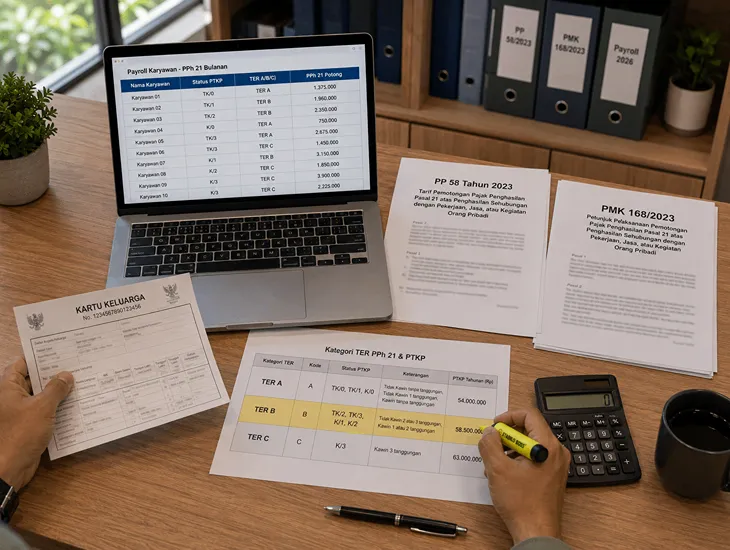
Many business owners in Bali struggle with tax calculations. Managing monthly salary deductions often leads to confusion for growing companies. Errors result in administrative mistakes.

These errors trigger significant risks during annual reconciliations. Inconsistent tax filings lead to unexpected audits from the tax office. Heavy fines often follow.

Understanding the current legal framework is essential for compliance. Ignoring these updates creates financial risks for your business in Indonesia. It jeopardizes your local standing.

The introduction of TER PPh 21 in Indonesia aims to simplify the process. However, many employers find the new categories and effective rates difficult. Correct implementation is mandatory.

Incorrectly mapping employee status causes persistent under-withholding. This creates a stressful environment for management and staff. It results in tax debt for the employees.

Our expert team streamlines your payroll and tax reporting. We ensure your business follows the 2026 rules perfectly. Professional support secures your financial compliance.

Defining the TER PPh 21 System

TER stands for Tarif Efektif Rata-rata. It is a simplified method for income tax withholding. This system applies to individual taxpayers in Indonesia.

The government introduced this regime to ease administration. It replaces the previous requirement of complex recalculations. Most payroll systems must now adapt.

The calculation uses a single effective rate. Employers apply this rate to gross monthly income. This method speeds up the reporting process.

This system covers permanent and non-permanent employees. It also includes recipients of professional fees. The rules target efficiency for the tax office.

The simplicity only applies to monthly withholding. Final annual tax still follows progressive rates. This distinction is crucial for accurate bookkeeping.

Companies must understand specific income bands. Each band corresponds to a different effective rate. Errors in selection lead to reporting discrepancies.

Tax services help businesses implement these tables. They ensure software matches current government standards. This reduces the risk of manual mistakes.

TER PPh 21 in Indonesia 2026 – Employee tax categories, PTKP thresholds, and payroll compliance for businesses in Indonesia
The legal basis is PP 58/2023. This regulation defines how employers withhold income tax. It provides the foundation for current payroll practices.

Implementation guidelines appear in PMK 168/2023. These rules detail the transition from old methods. Every business in Indonesia must follow them.

The system uses three main categories. These categories depend on the non-taxable income threshold. This threshold is known as PTKP in Indonesia.

Category A applies to single taxpayers without dependents. It also covers married individuals with no children. This group has the lowest threshold.

Category B includes taxpayers with one or two dependents. Most married employees with families fall here. The PTKP is higher than Category A.

Category C is for taxpayers with three dependents. This is the highest threshold for standard calculations. Accurate mapping prevents tax shortfalls.

Employers must verify the family status of workers. They should collect updated family cards and documents. This data ensures correct category selection.

Misclassification is a frequent error in Indonesian payroll. It causes incorrect tax amounts to be withheld. The tax office flags these inconsistencies.

Monthly withholding uses effective rates for simplicity. Employers apply the percentage directly to gross income. This is the standard from January to November.

The December calculation is different. It requires a full annual reconciliation. Employers calculate the total annual tax using progressive rates.

This process ensures total tax paid is correct. Progressive rates follow Article 17 of the Income Tax Law. It considers all deductions.

Employers subtract tax withheld from January to November. The remaining balance is the tax for December. This step prevents year-end overpayment.

The tax portal provides guides on this transition. Businesses must reconcile these figures before filing reports. Accuracy is vital.

Non-permanent workers follow different rules for daily payments. If daily income exceeds a limit, progressive rates apply. This transition happens at 2.5 million.

Managing these methods requires tracking of income. Payroll staff must monitor daily averages for freelance staff. This prevents misapplication of rates.

Manual tracking often leads to significant calculation errors. Professional payroll software automates these transitions. Automation protects companies from administrative sanctions.

Mapping PTKP status incorrectly is a major risk. Employees often forget to update their marital status. This results in the wrong category.

Applying effective rates to the wrong income is common. Some payments require progressive rates even for monthly withholding. Bonuses often fall here.

Failing to switch methods for high-earning workers is dangerous. If a freelancer earns above the limit, rules change. Companies miss this threshold.

Incorrect December reconciliations lead to massive tax gaps. The tax office uses data matching to find errors. Discrepancies trigger official investigations.

System misconfigurations in HRIS software cause many mistakes. Software not localized for Indonesia often fails. These systems lack the latest tables.

Invalid identification numbers also cause reporting failures. Every employee must have a validated NIK or NPWP. Tax rates increase without them.

Foreign companies struggle with these local nuances. They might use international payroll providers lacking local expertise. This creates high risk for businesses.

Outsourcing to local tax experts mitigates these risks. They provide oversight for complex Indonesian regulations. This ensures every filing meets standards.

When Maria, a 42-year-old yoga instructor from Italy, first opened her studio in Ubud, she struggled with complex payroll updates. The heat of the afternoon made manual bookkeeping feel impossible.

The transition to the new tax calculation method caused her significant stress. She felt confused by the different tax categories for her five local employees.

Maria worried about failing to claim the 2026 tax incentives for her team. Her spreadsheet formulas were inaccurate and resulted in persistent errors. She feared a tax audit.

That is when she used our professional services to manage her monthly reporting. We updated her records and validated all identification numbers. This secured the subsidies for her workers.

Maria now focuses on her yoga retreats without administrative worry. Her payroll system is automated and compliant. She avoids penalties and protects her studio’s finances.

TER PPh 21 in Indonesia 2026 – Government policy evaluations, tax reporting standards, and compliance audits for expats in Bali
The Directorate General of Taxes is currently evaluating the system. They want to ensure the effective rates work. This targets improvements for 2026.

Stakeholders provided feedback regarding the technical challenges. Some employers find system instability difficult. The tax office aims to simplify portals.

Vertical equity remains a topic of discussion. There are concerns about how rates affect non-regular income. Future adjustments may refine the bands.

Businesses must stay updated on these policy shifts. Rules valid in 2024 might change soon. The government issues circulars to clarify regulations.

Our firm monitors all announcements from the tax office. We provide clients with immediate updates on changes. This approach keeps your business compliant.

Interpretation differences lead to legal uncertainty. Different tax offices might view specific provisions differently. Expert guidance helps resolve these ambiguities.

Implementation costs were high for many companies initially. Updating software and training staff required resources. The goal is to reduce burdens.

The evaluation process ensures the system remains fair. It balances the needs of the government and taxpayers. Understanding trends helps in financial planning.

Verify all employee data before the first payroll run. Collect copies of family cards and tax IDs. This is the foundation of withholding.

Use localized payroll software for your business. Avoid international systems that do not support local tables. Ensure software updates with new rules.

Communicate clearly with your staff about tax categories. Explain how the effective rate system works. This prevents confusion regarding take-home salaries.

Conduct a mid-year audit of your payroll records. Check for any mapping errors or missed threshold changes. Fixing mistakes prevents large December adjustments.

Maintain a digital archive of all tax slips. These documents are essential during government inspections. Organized records demonstrate commitment to legal compliance.

Train your HR team on the latest tax regulations. They should understand the difference between worker types. Continuous education reduces the risk of error.

Consult with a tax specialist for complex payment structures. Bonuses and severance pay require special attention. Professional advice ensures you apply correct rates.

Stay informed about changes in non-taxable income limits. The government might adjust PTKP thresholds. These changes affect the mapping of all employees.

Setting up a business in Bali involves tax obligations. Managing TER PPh 21 in Indonesia is a core part. Our team provides comprehensive solutions.

We handle monthly withholding and electronic filing. Our experts map each employee to the correct category. This removes the burden from your management.

Our services include the critical December tax reconciliation. We ensure annual reports match monthly filings. This protects your company from official inquiries.

We assist with NIK and NPWP validation. This is essential for claiming the 2026 tax incentives. We ensure your business enjoys government subsidies safely.

Foreigners employing household staff also need tax support. We provide payroll solutions for workers in Bali. This ensures your affairs remain fully compliant.

Our team has deep experience with foreign-owned companies. We understand the specific challenges faced by investors. We align global standards with local regulations.

Outsourcing your tax functions saves time. You can focus on growing your business or lifestyle. We handle the technical details of Indonesian compliance.

Contact us today for a consultation on your payroll needs. We provide clear pricing and professional support. Let us secure your financial future.

It simplifies calculations by using fixed effective rates for TER PPh 21 in Indonesia.

No, the total annual tax remains the same as progressive rates.

Married taxpayers who have exactly three dependents use Category C.

It leads to incorrect withholding and potential penalties during audits.

No, employees must meet income limits and have validated NIK data.

Failing to report leads to administrative fines, interest penalties, and full corporate audits.

Need help with TER PPh 21 in Indonesia, Chat with our team on WhatsApp now!

jmacompany@gmail.com

This author has not yet provided a bio.