

PPh 21 TER in Indonesia: Why DJP Wants a Review
Many foreign employers struggle with monthly payroll calculations. Managing accurate salary deductions creates confusion for growing businesses in Indonesia. Administrative mistakes often occur during this process.
These calculation errors trigger significant financial risks. Inconsistent filings lead to unexpected audits from the official tax authority. Heavy administrative fines often follow.
Understanding the current legal framework is essential. Ignoring technical updates creates severe liabilities for your enterprise. It jeopardizes your corporate standing and personal residency.
The introduction of the new effective rate system aims to simplify reporting. However, many teams find these specific percentages difficult to apply correctly. Accurate mapping is mandatory.
Incorrectly mapping employee status causes persistent under-withholding. This creates a stressful environment for company management. It results in unexpected debt for your staff.
Our expert team streamlines your monthly payroll processing. We ensure your enterprise follows the 2026 rules perfectly. Professional support secures your long-term financial compliance safely.
Table of Contents
- Understanding the New Calculation Formula
- How PPh 21 TER in Indonesia Works
- The Core Reasons for Official Evaluation
- Common Payroll Mistakes for Expatriates
- Overcoming Payroll Hurdles in Canggu
- Navigating the December Reconciliation
- Technical Risks for Foreign Investors
- Securing Professional Tax Support
- FAQs about PPh 21 TER in Indonesia
Understanding the New Calculation Formula
The government continuously updates its revenue collection methods. The latest scheme uses an effective rate for monthly salary deductions. This method replaces older complex calculation models.
This simplified structure applies to individual taxpayers. It aims to reduce the monthly administrative burden on local employers. Most payroll systems must adapt to these new formulas.
The calculation uses a single flat percentage. You apply this rate directly to the gross monthly income. This approach speeds up the regular reporting cycle significantly.
However, the transition requires careful attention to detail. Human resource teams must understand the specific legal guidelines. These rules are outlined clearly in government regulation PP 58/2023.
This new method does not change the final annual liability. It only alters how monthly installments are collected. Accurate tracking remains strictly necessary for proper bookkeeping.
The implementation of PP 58/2023 formalized these new rules. This regulation provides the strict legal basis for current withholding structures. Employers must study this document carefully to maintain compliance.
Companies must implement these changes to avoid compliance issues. Using outdated software leads to incorrect salary distributions. You must update your internal accounting practices immediately.
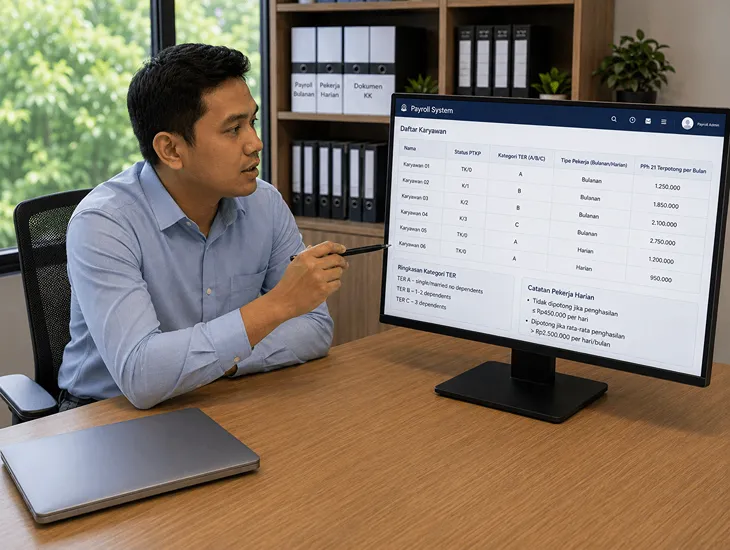
The system divides employees into three distinct categories. These groups depend on the non-taxable income threshold. This threshold is legally known as PTKP.
Category A covers single individuals without dependents. It also includes married taxpayers with no children. This group has the lowest non-taxable threshold available.
Category B applies to married employees with one or two dependents. The effective rates for this group are slightly lower. You must verify family status documents annually.
Category C is strictly for taxpayers with three dependents. This specific group receives the highest relief threshold. Using this category incorrectly causes massive revenue shortfalls.
Daily workers face different calculation thresholds entirely. If daily wages exceed 450,000 Rupiah, a specific effective rate applies. Managing these variables manually is highly inefficient.
If daily averages cross 2.5 million Rupiah, the rules change again. The system switches back to standard progressive rates. Automated payroll software handles these transitions safely.
Gathering proper documentation is your first line of defense. You must securely collect family cards for all local employees. This proves your category selections are factually correct.
Correct implementation of these updated rules is mandatory. The authorities use digital systems to verify your reports. Any data mismatch triggers an immediate administrative warning.

The Directorate General of Taxes is evaluating this new system. They openly acknowledge the need for technical refinements. The goal is a fairer withholding mechanism for everyone.
Prior to this scheme, there were hundreds of different deduction scenarios. The new method compressed these into simpler tables. However, this extreme simplification created unexpected problems.
Many employees submitted complaints regarding their monthly take-home pay. They felt their deductions increased sharply during specific months. This usually happened when they received bonuses.
The system combines routine and non-routine income. A large bonus significantly increases the withholding amount for that specific month. This adjustment alters standard expectations.
The authorities want to ensure the rules are clearer. They recognize that human resource teams need better technical guidance. Further regulatory adjustments are expected soon.
The integration with the new digital administration system is underway. This upgrade gives the government unprecedented visibility into your corporate records. It demands absolute accuracy from your accounting team.
Business owners must monitor these ongoing policy shifts carefully. The fundamental structure will remain in place. However, the specific rate tables might change to improve fairness.
Foreign managers often rely on international software tools. These global platforms usually lack proper local localization. This creates a high risk of systematic under-withholding.
Misclassifying the PTKP status is the most frequent error. Employees often forget to report marriage or childbirth. This outdated information leads to incorrect category mapping.
Handling holiday allowances creates major compliance friction. Combining these payments with regular salaries alters the applicable rate. Clear communication from management is necessary to prevent confusion.
Correct application of tax withholding rules in Indonesia is vital. Companies often miss the daily income limits during busy periods. This results in severe technical non-compliance.
Visa types directly influence your fiscal obligations. Expatriates holding temporary residency permits face specific local regulations. You must apply standard withholding to their local compensation packages immediately.
Incomplete documentation for foreign staff adds another layer of risk. Expatriate workers must possess valid identification numbers. You cannot file correct reports without this validated data.
Frequent return amendments increase your overall corporate risk profile. Constantly correcting past mistakes signals weak internal controls. The authorities often target these businesses for comprehensive audits.
David, a 40-year-old software agency founder from Germany. He opened a new development hub in Canggu. He managed a team of eight local developers at his new agency.
David hired eight local developers for his new team. However, navigating the local administrative requirements proved difficult. He struggled to categorize his staff correctly.
He misapplied the effective rates due to missing family cards. This error caused persistent under-withholding for his senior developers. David worried about facing a costly government audit.
He experienced a technical error within the official digital portal. The system rejected his monthly filing due to an identification mismatch. He spent hours trying to correct the digital error.
He contacted our expert consultants to resolve this discrepancy. We audited his records and corrected the PTKP mapping immediately. We secured his compliance for the 2026 fiscal year.
David now focuses entirely on scaling his software agency. His monthly reporting is fully automated and legally sound. Professional oversight eliminated his administrative stress completely.
December is the most critical period for tax reporting. You must reconcile all monthly deductions against the actual annual liability. This process ensures total financial accuracy.
The calculation reverts to standard progressive rules in the final month. You must calculate the total annual gross income first. Then, you subtract all allowed legal deductions.
You apply the progressive rates to determine the final liability. Next, you subtract the total amount already withheld previously. The remaining balance dictates the December payment.
This often results in a significant top-up requirement. If previous installments were too low, the December bill increases sharply. Employers must prepare their staff for this adjustment.
Allowed deductions include the standard occupational expense limit. This reduces the total taxable income before progressive rates are applied. Properly calculating these deductions lowers the final fiscal burden legally.
Accurate reconciliation prevents mismatches with individual annual returns. The government cross-references corporate filings with personal submissions. Any data discrepancy initiates an official investigation.
Handling employee terminations requires the exact same reconciliation process. You must compute the final liability during their last working month. Immediate action prevents lingering corporate liabilities.

Foreign investors face intense scrutiny regarding their financial operations. The authorities expect international enterprises to maintain perfect records. Small administrative errors quickly escalate into formal investigations.
Foreign-owned entities face higher scrutiny during these collection drives. The authorities assume that international businesses possess the resources to maintain perfect compliance. Minor discrepancies often trigger comprehensive compliance reviews.
You must actively audit your internal reporting mechanisms regularly. Catching an error internally is always the safest approach. Voluntary corrections prevent forced audits and heavy financial penalties.
Independent contractors fall under completely different withholding provisions. You must clearly distinguish between permanent staff and freelance workers. Misclassifying these roles triggers immediate compliance warnings.
Attempting to process salaries offshore incorrectly is highly illegal. International data sharing agreements provide broad visibility into global accounts. You must process local salaries through compliant domestic channels.
The 2026 compliance landscape requires a highly proactive strategy. The government expects perfect integration between your systems and their portals. Falling behind guarantees regulatory trouble for your enterprise.
Maintaining a clean corporate structure is vital for long-term success. You must separate personal assets from your business entities clearly. Commingling funds is a major warning sign for official investigators.
The fiscal climate requires constant and careful observation. Setting your payroll logic once and ignoring it is dangerous. You need continuous monitoring of all regulatory circulars.
Professional consultants protect your corporate compliance effectively. We align your international business standards with official government guidelines. This ensures your operations remain completely legitimate.
Our services provide peace of mind for foreign investors. We ensure your corporate finances and business operations remain safe. You can secure your investment with our local expertise.
We help you navigate the complexities of these effective rates. Our team handles everything from monthly deposits to year-end filings. We deliver total precision for your enterprise.
Partnering with experts shields you from sudden policy shifts. We absorb the complexity of local regulations so you do not have to. Contact us to safeguard your business operations today.
Avoid the heavy penalties associated with collection shortfalls. Let our experts manage your reporting requirements seamlessly. You can focus on achieving your core business goals.
We provide tailored solutions for foreign companies and small villas. No matter the size of your staff, we guarantee compliance. Professional support is an investment in your success.
No, it only changes the distribution of monthly withholding installments for PPh 21 TER in Indonesia.
It aims to simplify the monthly calculation process for all employers.
No, December requires a full progressive calculation based on annual income.
Yes, if they are considered domestic residents during that fiscal year.
It causes under-withholding, which triggers audits and severe financial penalties.
No, bonuses are added to the gross income for the monthly calculation.
Need help with PPh 21 TER in Indonesia, Chat with our team on WhatsApp now!
jmacompany@gmail.com
This author has not yet provided a bio.