
Tax Administrative Penalties in Indonesia 2026 – Corporate compliance rates and legal tax audits
May 29, 2026

Latest Interest Rates for Tax Administrative Penalties in Indonesia

Foreigners face complex tax structures today. Managing compliance requires precise knowledge of local regulations. Many investors struggle with these regular changes.

The government sets variable interest charges. Late payments trigger immediate financial consequences. Minor errors cause a significant financial drain for companies.

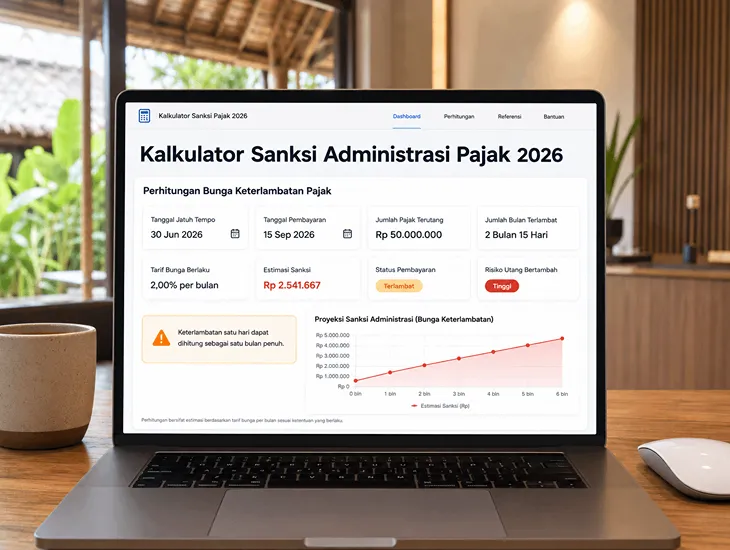
Ignoring updates leads to compounding corporate debt. A single late day counts as a full month. Strict rules penalize simple oversight.

You cannot rely on outdated rates anymore. The new official tax regulations impose dynamic costs. Unpaid taxes spiral out of control.

You need accurate financial data to protect assets. Professional compliance guidance prevents costly mistakes. Expert oversight secures your business operations.

How Tax Administrative Penalties in Indonesia Are Calculated

The Omnibus Law transformed how the government calculates tax fines. The system uses a variable base interest rate today. This rate comes directly from the central bank benchmark.

An uplift factor applies based on your specific violation severity. The Ministry of Finance publishes these exact rates monthly. Taxpayers must monitor these updates for compliance.

Severe corporate underpayments carry the highest possible uplift factors. The monthly penalty can reach 2.24 percent. Intentional evasion triggers these maximum financial punishments.

Minor late payments incur lower percentage charges overall. The rate sits near 0.57 percent for simple delays. Quick settlement prevents these small fines from compounding.

Self-correction of returns causes specific interest charges for companies. The rate currently sits near 0.99 percent monthly. This applies to delayed payments after the official due date.

Tax deficiencies from official audit findings incur significant costs. These official assessments apply a 1.82 percent monthly rate. Companies face severe financial risks during formal audits.

You must apply the correct mathematical formula for calculations. The central bank rate plus the factor determines the total. Accurate reporting prevents these additional regulatory compliance costs.

Indonesia Tax Fines 2026 – Monthly corporate penalties, fixed late fees, and reporting schedulesLate filing triggers immediate fixed financial penalties in Indonesia. These fines apply independently of any compounding interest charges. The tax office issues collection letters fast.

Missing a monthly value-added tax return costs money. The mandatory fine is 500,000 Indonesian Rupiah per document. You must submit this specific return every month.

Monthly income tax returns follow strict filing rules. Late submissions result in a 100,000 Rupiah penalty fine. Individual taxpayers must observe these mandatory deadlines.

Annual corporate tax returns carry the highest fixed penalties. Corporate entities pay 1,000,000 Rupiah for late document submissions. Businesses must prioritize their annual reporting schedules.

These fixed fines compound alongside any unpaid tax interest. You face dual penalties for late documents and missing payments. Timely administration is vital for continuous business survival.

The tax authority actively monitors all registered foreign taxpayers. Automated government systems flag missed document deadlines. The official collection process begins without human intervention.

Proper scheduling prevents these unnecessary fixed financial penalties. Tax calendar management ensures consistent regulatory alignment for companies. We track these critical dates for our corporate clients.

The revised tax laws introduced a critical protection measure. Interest accumulation now stops at a specific point. The government caps financial penalties at twenty-four months.

Previous regulations allowed unlimited compounding interest on corporate debts. Tax liabilities could exceed the original principal amount. The current system provides a defined maximum liability.

A partial month counts as a full month for interest. Being one day late triggers a complete monthly charge. This strict rounding rule catches many taxpayers unprepared.

An unpaid official assessment notice accrues interest fast. A 0.57 percent monthly rate applies directly to the balance. The maximum penalty reaches 13.68 percent over two years.

Self-correction underpayments face a similar compounding interest structure. A 0.99 percent rate reaches 23.76 percent maximum. You must settle these balances swiftly to avoid caps.

This cap applies to most standard corporate administrative penalties. It limits the total financial exposure for struggling local companies. Prompt initial payment remains the best financial strategy.

Understanding these limits prevents panic during official tax audits. The two-year cap provides a predictable maximum cost. Accurate tax planning accounts for these potential long-term liabilities.

Missing deadlines triggers immediate financial sanctions for any business. The official tax calendar dictates all payment and filing schedules. You must align your accounting with these dates.

Monthly individual income tax requires prompt financial payment. You must pay by the fifteenth of the following month. The official document filing deadline falls on the twentieth.

Employee withholding tax follows a similar strict timeline. Companies pay the deducted payroll amounts by the tenth. They file the official corporate return by the twentieth.

Annual income tax deadlines vary by the specific taxpayer type. Individuals file by the third month after the year-end. Corporate entities have until the fourth month.

Interest calculations begin one day after the deadline passes. The digital system applies the full monthly rate immediately. Grace periods do not exist in the current regulations.

Proper payment routing is essential for maintaining strict compliance. You must use official payment channels and specific billing codes. Incorrect payment codes result in rejected transactions.

Tracking these mandatory dates manually often leads to errors. Automated bookkeeping systems provide necessary deadline alerts. Professional services ensure you never miss a critical compliance date.

Meet James, a thirty-five-year-old architect from the UK. He manages a boutique design firm in Uluwatu. The business grew fast, and he struggled to manage his employee withholding tax correctly.

He relied on outdated fixed penalty rates for his late filings. The government issued formal Tax Administrative Penalties in Indonesia. The compounding interest on his corporate debt shocked him.

The stress built up as he reviewed the collection letter. He sat in his humid studio listening to the passing traffic. He needed a reliable solution to protect his firm.

He contacted our tax advisory service in Indonesia for help. Our team audited his payroll records to identify the exact discrepancies. We found the specific calculation errors in his submissions.

We submitted a formal penalty reduction request to the authorities. We proved the calculation error was an unintentional administrative mistake. The tax office accepted our formal correction documents.

James avoided the maximum two-year interest cap on his debt. He saved millions of Rupiah through our direct professional intervention. He now focuses on designing luxury villas instead of paperwork.

Our reliable compliance support protects his growing architecture business daily. He handles his operations while we manage his corporate tax obligations. His firm remains secure from unexpected regulatory fines.

Indonesia Tax Audits 2026 – Corporate compliance risks, audit penalties, and legal reportingForeign investors face higher scrutiny from local authorities. Cross-border transactions attract intense regulatory attention. Errors in withholding tax trigger severe corporate financial penalties.

Incorrect employee tax deduction remains a common mistake. Failing to withhold results in massive monetary sanctions for employers. Companies pay a complete penalty on the undeducted amount.

Value-added tax invoices require precise issuance timing. Late issuance triggers a fixed percentage penalty on the transaction. This fine applies directly to the total commercial base.

Audit findings often result in substantial financial underpayment assessments. These official assessments carry high compounding monthly interest rates. Compounding interest damages corporate cash flow predictability.

Foreign-owned companies experience frequent and detailed regulatory audits. The authorities review all international fund transfers carefully for compliance. Proper documentation prevents devastating official financial assessments.

Dividends and royalties require specific withholding tax treatments. Mistakes here trigger automatic twenty percent withholding taxes for companies. High interest rates compound rapidly on these specific errors.

Accurate bookkeeping remains your only defense against audits. Transparent financial records prove your corporate compliance easily. Professional preparation removes the massive risk of costly errors.

The tax law provides specific legal mechanisms for relief. Taxpayers can apply for official reduction or complete fine annulment. You must submit a detailed formal written request.

The government does not guarantee approval for requests. You must provide valid factual justification for your compliance failure. Acceptable reasons strictly include proven system errors or disasters.

Financial hardship rarely qualifies for complete tax penalty elimination. The tax office comprehensively reviews your entire historical compliance record. A poor regulatory record results in formal rejection.

Formal installment plans exist for massive corporate debts. You can legally request a postponement of your required payments. However, the standard compounding monthly interest rate still applies.

The tax authority occasionally compensates taxpayers for administrative delays. This happens when official refund processes face operational delays. Taxpayers earn a small monthly interest on verified overpayments.

Submitting a successful reduction request requires extensive supporting documentation. You must prove your case with concrete factual financial evidence. Vague explanations result in immediate administrative denial.

Professional representation increases your formal approval chances today. We draft compelling reduction requests for our corporate clients. We handle all direct communication with the local tax authorities.

Monthly rate changes require constant administrative monitoring. Missing a minor percentage increase causes steady corporate penalty creep. These small hidden leaks drain corporate resources over time.

The strict partial month rule demands absolute deadline precision. A single day error literally costs thirty days of interest. Manual tracking simply cannot guarantee this crucial level of accuracy.

Foreign companies face higher operational audit rates locally. Compliance errors trigger maximum penalty assessments frequently for these entities. Professional support shields your business from these targeted investigations.

Navigating new digital tax systems is highly complex. Filing delays cause widespread panic among unrepresented foreign business owners. We manage these technical transitions smoothly for our international clients.

Cross-border transactions contain hidden regulatory traps for investors. Simple dividend payments require careful international corporate tax planning. We ensure all international transfers meet strict local legal regulations.

Professional compliance support prevents maximum penalty accumulation. We turn potential financial liabilities into manageable operational expenses. Protect your investment with our dedicated corporate tax services.

Navigating compliance regulations is vital for your company. You need a reliable partner for continuous financial safety. Our dedicated team provides accurate reporting and strategic advice.

The Ministry of Finance updates the penalty rates monthly based on central bank interest figures.

Yes, the tax authority caps compounding interest at a strict maximum of twenty-four months exactly.

A single day of delay triggers a full month of interest due to the partial month rounding rule.

Corporate entities must pay a fixed fine of 1,000,000 Rupiah for late annual tax return filings.

You can request reductions, but the tax office only approves cases with proven valid justifications.

Need help with Tax Administrative Penalties in Indonesia, Chat with our team on WhatsApp now!

jmacompany@gmail.com

This author has not yet provided a bio.