
Income Tax Non-Compliance Risks: Tax Invoice Issuance Access Revoked in Indonesia

Managing a business in Indonesia demands strict regulatory adherence. Foreign entrepreneurs frequently struggle to track updated local reporting schedules. Missing these critical submission deadlines causes severe administrative disruptions.
The government recently tightened enforcement mechanisms for registered businesses. Officials now monitor monthly filing submissions using upgraded digital systems. Failing to submit documents invites immediate governmental scrutiny.
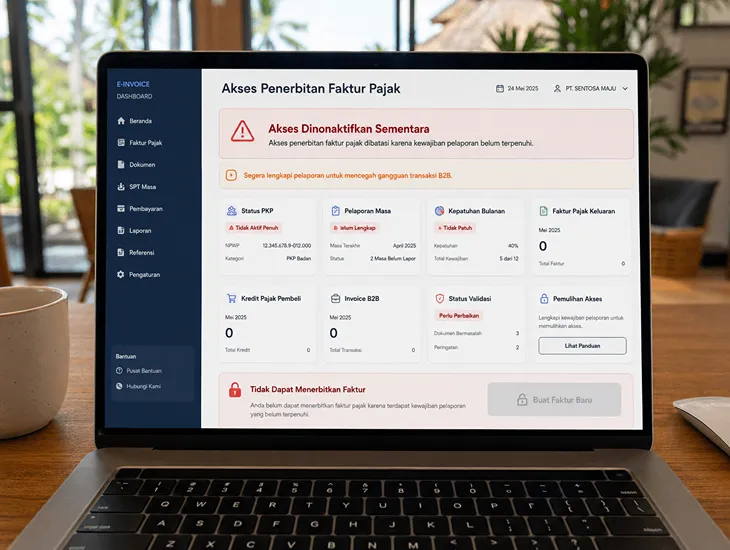
Severe non-compliance risks directly threaten your daily commercial operations. Authorities can abruptly deactivate your ability to generate official invoices. This unexpected block completely freezes your local revenue streams.
Without valid invoices, B2B clients cannot claim their input credits. These frustrated partners will likely terminate your service contracts quickly. This immediately damages your corporate reputation and financial stability.
Professional bookkeeping shields your enterprise from these aggressive enforcement actions. We organize your financial ledgers to meet all official deadlines. You can focus your energy on expanding your local market share.
Verifying rules through official taxation portals clarifies your corporate obligations. Our expert accountants manage these complex regulatory filings for your company. Secure your commercial longevity in Indonesia with our dedicated assistance.
Table of Contents
- Understanding Invoice Access Revocation in Indonesia
- Legal Basis for Tax Document Deactivation
- Six Triggers for Invoice Deactivation
- Operational Consequences of Income Tax Non-Compliance Risks
- Real Story: Restoring Invoice Access in Canggu
- How to Clarify and Restore Access
- Financial Penalties for Missing Deadlines
- Preventive Checklists for Corporate Entities
- FAQs about Invoice Access in Indonesia
Understanding Invoice Access Revocation in Indonesia
The state expects all registered corporate entities to follow strict reporting rules. Authorities penalize businesses failing to meet these basic administrative mandates. The newest enforcement tool disables your billing capabilities.
Authorities deactivate access for companies ignoring their monthly submission duties. This digital lock prevents you from generating legitimate commercial documents for clients. You cannot conduct normal B2B transactions under these conditions.
Major administrative compliance failures arise when managers ignore filing schedules. Missing three consecutive monthly reports triggers an automatic system block. Revenue officers execute these deactivations without issuing prior warnings.
Foreign investors must oversee their local accounting staff meticulously. Relying on untrained personnel often leads to catastrophic reporting failures. Professional oversight prevents these sudden operational shutdowns.
Understanding Income Tax Non-Compliance Risks helps you maintain excellent corporate standing. Consistent financial monitoring ensures your business avoids unexpected portal lockouts. You must always prioritize regulatory adherence over basic operational expansion.

A recent ministerial regulation introduced strict billing access restrictions. This updated legal framework targets noncompliant corporate entities directly. The policy became fully active during the final quarter of last year.
The regulation grants regional revenue directors the authority to suspend digital billing access. They target registered entities failing to submit mandatory monthly reports. This mechanism forces immediate adherence to national laws.
Another related regulation specifically addresses fraudulent billing practices. The current framework focuses strictly on general administrative negligence. Businesses must understand both distinct legal threats to survive.
Understanding these varied administrative threats requires professional corporate guidance. Foreign directors often misinterpret translated regulatory documents. Our firm translates these complex administrative demands into actionable business strategies.
Maintaining accurate corporate records provides essential protection against sudden regulatory shifts. Proactive financial management keeps your enterprise ahead of aggressive governmental enforcement. Secure your daily operations by partnering with reliable experts.

The state established six specific criteria triggering immediate access suspension. Failing to collect or withhold required levies for three months initiates a block. This applies heavily to expatriate payroll deductions.
Missing a single annual corporate return deadline constitutes another primary trigger. Many foreign owners mistakenly assume late filing only incurs small fines. This oversight stops your commercial invoicing.
Skipping monthly value-added reports for three consecutive periods guarantees deactivation. Missing six nonconsecutive monthly reports within one calendar year yields identical results. Consistent filing remains mandatory for business survival.
Accumulating severe corporate arrears above two hundred fifty million rupiah triggers suspensions too. The state issues a formal warning letter before applying this specific block. Immediate payment prevents the ensuing disruption.
Failure to submit official collection slips represents the final critical trigger. These triggers represent severe Income Tax Non-Compliance Risks for your growing company. Meticulous documentation prevents these technical failures perfectly.
Losing your ability to generate legitimate commercial billing paralyzes your company. You cannot charge standard value-added fees to your commercial customers legally. This stops your corporate cash flow.
Your corporate partners require valid billing to process their own deductions. They will refuse your services if you cannot provide official documentation. This reality destroys your established commercial relationships rapidly.
These severe administrative reporting failures do not revoke your core business license. The suspension remains active until you resolve all outstanding administrative failures. Resolving these issues takes valuable time.
The government sends official notifications to both the issuing company and the client. This public transparency damages your professional reputation locally. Competitors easily capture your frustrated commercial clients.
Rebuilding damaged commercial trust takes years of flawless operational performance. Preventing these public embarrassments requires dedicated internal financial auditing. Secure your corporate reputation by prioritizing strict monthly reporting procedures.
Markus runs a successful software development agency based in Canggu. During a busy period of acquiring new international clients, he delegated his local financial reporting to a junior administrative assistant.
His panic rose rapidly as he realized the severity of a sudden regulatory block. He attempted to issue a large monthly invoice to his biggest B2B partner, but the portal locked him out.
His assistant had missed three consecutive monthly value-added reporting deadlines. Because he could not provide a valid tax invoice, his client’s finance department refused to process his payment.
His tech startup faced severe cash flow disruptions. He could not pay his developers or cover his office rent. The regional revenue office flagged his corporate profile for administrative negligence.
He hired our specialized accounting team to intervene immediately. We compiled his missing reports, submitted them to the regional office, and paid his minor accumulated administrative fines.
Our team submitted the mandatory written clarification to the regional director. We successfully restored his digital billing access within two weeks, allowing him to recover his pending client payments safely.
Restoring your suspended billing capabilities requires a formal written clarification procedure. You must submit this detailed document to the regional revenue director directly. Electronic submissions accelerate this bureaucratic process.
Your submission must include comprehensive proof of complete regulatory adherence. Corporate entities must attach their official registration documents and management identification cards. You must resolve all outstanding arrears first.
The state holds a maximum thirty-day window to evaluate your clarification request. This waiting period halts your commercial transactions completely. Flawless initial submissions prevent frustrating rejections and extended delays.
Mitigating these operational blockades requires expert administrative representation. We prepare your clarification documents to meet all strict governmental standards perfectly. Trust our professionals to expedite your operational restoration securely.
Navigating bureaucratic appeals demands deep local regulatory knowledge. Amateurs frequently submit incomplete clarification packages that restart the waiting period. We guarantee your corporate documents satisfy all official reviewing criteria.

Missing monthly or annual deadlines incurs immediate fixed monetary penalties. The state applies specific fines for every single unsubmitted regulatory document. These initial fines appear relatively small and manageable.
However, the hidden costs of billing suspensions dwarf these standard fines. Losing a major commercial client costs significantly more than a late filing fee. You must view compliance holistically.
Authorities calculate compounding interest on any unpaid corporate arrears. This interest accrues monthly until you settle the entire outstanding balance. Delaying payments drains your operational capital reserves completely.
Operating a company with suspended billing capabilities invites deeper intelligence investigations. Revenue officers scrutinize suspended entities for potential fraudulent activities. Our proactive management shields your company from these aggressive audits.
Protecting your corporate assets requires consistent monthly financial vigilance. Outsourcing your accounting duties eliminates the stress of managing these strict deadlines. We safeguard your commercial profits from unnecessary administrative losses.
Preventing sudden digital access suspensions requires rigorous monthly internal audits. You must withhold and report all applicable employee deductions accurately every period. Keep detailed records of every generated commercial document.
Submit your monthly value-added reports punctually before the final calendar week. Track your annual corporate submission deadlines meticulously to avoid overlapping requirements. Precision eliminates unnecessary administrative anxiety entirely.
Monitor your corporate arrears regularly using the official centralized digital portal. Apply for an approved installment plan if you cannot settle large balances immediately. Approved installment plans prevent sudden suspensions.
Avoiding Income Tax Non-Compliance Risks prevents sudden business shutdowns. Maintain complete physical and digital copies of all submitted regulatory documents permanently. Our dedicated bookkeepers archive your data systematically.
Partnering with reliable accounting professionals removes the burden of constant regulatory monitoring. We implement proven corporate reporting frameworks for your local enterprise. Build your successful commercial venture in Indonesia securely.
Missing three consecutive monthly submissions or ignoring your annual reporting deadlines causes immediate deactivation blocks.
No, your core license remains active, but you cannot issue valid commercial documents to clients.
The regional director has a maximum thirty-day window to review your clarification letter upon submission.
No, you cannot legally charge or collect value-added fees without official digital documents.
Yes, maintaining a formally approved payment plan prevents suspensions related to outstanding corporate arrears.
Need help with Income Tax Non-Compliance Risks, Chat with our team on WhatsApp now!
jmacompany@gmail.com
This author has not yet provided a bio.