
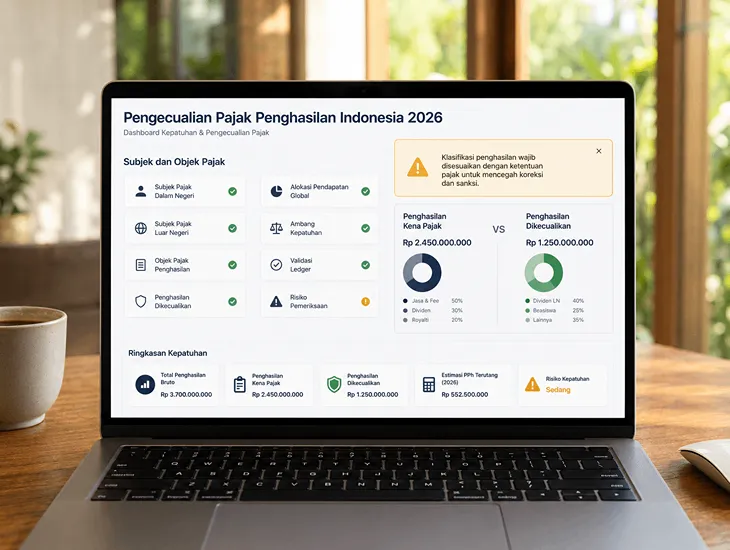
Income Tax Exemptions in Indonesia 2026 – Legal filing requirements, PT PMA compliance, and tax regulations for WNAs
May 25, 2026

Income Tax Exemptions in Indonesia: List of Tax Subjects and Objects

Navigating foreign fiscal frameworks presents severe hurdles for international founders. Many businesses launch operations without realizing how local authorities evaluate worldwide revenue allocations.

Fragmented regulations create immediate friction for growing enterprises. Outdated records fail to shield your assets from intense scrutiny during sudden state audits.

Ignoring compliance thresholds risks your entire operational cash flow. Revenue officers enforce strict collections that trigger immediate financial penalties, disrupting your corporate expansion plans.

Unresolved ledger mismatches can freeze active corporate banking channels. These compounding liabilities threaten your long-term commercial viability and undermine vital investor relationships.

Fortunately, syncing your files with official tax regulations eliminates processing errors. Proper documentation protects your personal holdings from arbitrary assessments.

Our firm clarifies the regulatory rules governing Income Tax Exemptions in Indonesia. We implement structured bookkeeping to insulate your funds.

Distinguishing Domestic and Foreign Tax Categories

The Directorate General of Taxes categorizes tax subjects into domestic and foreign classifications. This primary division determines whether your global revenue falls under local fiscal jurisdiction.

Domestic subjects face taxation on their worldwide earnings, regardless of source location. Conversely, foreign subjects owe liabilities exclusively on income derived from transactions within the country.

Understanding this structural separation prevents unexpected double-taxation scenarios for international directors. Corporate management must evaluate their specific operational profiles before executing distribution agreements.

Misinterpreting these jurisdictional boundaries can lead to severe financial tracking errors. Companies must verify the residency status of their remote workforce regularly to maintain high compliance scores.

Our accounting specialists analyze your business footprint to guarantee clear classification alignment. We establish bulletproof structures that preserve your corporate wealth from aggressive assessments.

Proactive categorization minimizes disclosure risks during seasonal filing windows. We guide your administration through every verification phase to support smooth cross-border commercial reporting routines.

Tax Residency Vetting Indonesia 2026 – Statutory timeline tracking, individual audit structures, and compliance for WNAs
Individual tax subject status relies heavily on objective physical presence metrics. Staying inside the country for more than 183 days within any twelve-month window triggers domestic classification.

Entering this bracket obligates individuals to declare their global personal financial assets. Expat families residing in a villa in Bali often overlook this critical timeline checkpoint.

The state also evaluates your explicit intention to reside through long-stay visas. Possessing an active work contract signals tax residency regardless of your exact day counts.

Tracking these statutory residency thresholds requires systematic calendar logging and professional oversight. We monitor your residency status continuously to prevent unexpected worldwide tax exposures.

Failing to plan your travel schedules can result in sudden tax residency reclassifications. International entrepreneurs must synchronize their entry dates with corporate operational calendars carefully.

Our advisors draft comprehensive residency logs that support your compliance declarations cleanly. We handle the documentation logistics to secure your private asset protection plans.

The legal framework offers unique fiscal incentives for qualified international entities. However, these statutory fiscal carve-outs remain highly fragmented across multiple minister decrees.

Assuming an income category is automatically tax-free represents a dangerous corporate mistake. Business owners must maintain rigorous document archives to substantiate every single exemption claim.

Clean ledger trails protect your expanding enterprise from aggressive reclassification actions by regional inspectors. Our firm maps out accessible exemptions to insulate your corporate revenue.

We verify your eligibility against active finance ministry guidelines before submitting annual returns. Professional tax planning ensures your commercial organization utilizes legitimate state incentives efficiently.

Fragmented legislation means that rules governing specific sectors shift without clear public warning. Companies require constant regulatory monitoring to adapt their corporate accounting lines to new parameters.

Implementing structured data systems protects your transaction files from unverified adjustment orders. We provide ongoing advisory support to stabilize your accounting channels throughout the year.

Resident individuals can minimize their personal liabilities by leveraging statutory non-taxable income thresholds. Recent ministerial updates explicitly exclude specific benefits-in-kind from your taxable personal income streams.

Permissible exemptions include employer-provided food allowances, corporate uniforms, and specific housing options. These corporate deliverables must satisfy strict value caps to remain outside the tax net.

Benefits outside these narrow conditions are reclassified as regular employment income instantly. Under-reporting company benefits or misapplying value limits invites immediate adjustments during payroll reviews.

Enterprises must implement precise internal evaluation systems to track employee asset distributions accurately. Our financial consultants configure your payroll software to isolate exempt categories.

We structure executive compensation packages to maximize these non-taxable benefits legally. Our specialized accounting ensures your company payroll remains fully compliant with updated ministerial regulations.

Aligning worker allowances with current fiscal guidelines eliminates friction with tax authorities. We construct robust compensation frameworks that safeguard your domestic workforce expansion investments.

State tax reforms introduce specific exemptions for corporate dividends distributed to resident individuals. These payouts become non-taxable objects provided the funds are reinvested within domestic markets.

The law mandates that matching assets must be held in approved financial instruments. Qualified options include state bonds, infrastructure projects, or direct equity additions.

Investors must retain these positions for a minimum mandatory period to secure the benefit. Withdrawing capital prematurely from selected instruments automatically invalidates your exemption status.

Managing these investment timelines demands pristine financial bookkeeping and constant regulatory alignment. For international shareholders, executing these reinvestment strategies safeguards long-term corporate profitability.

Our consultants handle the mandatory electronic reporting workflows required to secure these dividend exemptions. We align your investment data with central databases to guarantee complete audit readiness.

Structured tracking protects your capital from unexpected retroactive reclassification actions. We design clean reporting pathways to confirm your investment lines fulfill all federal compliance criteria.

Corporate Accounting Audit Indonesia 2026 – Ledger reconciliation systems, transaction tracking, and tax files for WNAsWhen Liam, a logistics manager from Australia, first arrived in Pererenan, he operated a cross-border distribution network. He encountered severe compliance bottlenecks regarding his offshore affiliate contracts.

He received an official audit notice regarding his unorganized financial records. His corporate banking profiles were subsequently frozen because his legacy files lacked valid data tracking.

The regional office flagged his enterprise for incorrectly reporting its worldwide service transactions. This operational delay threatened his seasonal cargo shipments and disrupted his local capital allocations.

Understanding the strict nuances governing national tax regulations became essential to save his business. He faced intense administrative pressure as examiners cross-checked his residency logs.

He worked closely with an experienced accounting squad to methodically untangle his cross-border transactions and compile valid documentation. This structured intervention quickly restored his compliance alignment.

We submitted a clean verification ledger directly to the central revenue database within twenty-four hours. Liam restored his active corporate accounts and managed his logistics network smoothly.

Corporate taxpayers can access specialized tax facility schemes to optimize their corporate setups. Certain capital injections, revaluation surpluses, and restructuring gains enjoy preferential or exempt treatment.

Some investment vehicles and specific government bonds allow businesses to reduce their tax exposure. However, navigating these corporate non-objects requires formal applications and strict eligibility mapping.

Miscalculating minimum shareholding percentages or failing to file required documentation triggers immediate reclassifications. Our firm evaluates your corporate structure to ensure safe utilization of these facilities.

Government-borne tax programs effectively convert taxable positions into subsidized lines for defined periods. These policy-specific incentives are time-limited and demand constant oversight from certified accountants.

We integrate these investment-level exemptions into your long-term financial forecasts securely. Our team prepares the necessary application files to protect your corporate returns from unexpected assessments.

Maintaining organized corporate documentation ensures full transparency during institutional asset validation rounds. We optimize your investment portfolio to secure structural tax reductions under active federal guidelines.

Passive revenue flows distributed to domestic residents face strict withholding protocols under active codes. Taxable items include standard royalty payments, technical service fees, and uninvested corporate dividends.

The state enforces automated tracking systems that monitor these distributions at the payor level. Misclassifying these passive streams as exempt allocations invites immediate physical inspections from revenue boards.

Failing to withhold taxes on domestic service contracts results in compounding interest fines. Outlining your strategic protections under active regulatory frameworks minimizes audit liabilities.

Modern database systems cross-reference corporate submissions against individual banking records continuously. Implementing organized data storage methods protects your enterprise from expensive reclassification assessments over time.

Our comprehensive consulting solutions manage your company setup, payroll lines, and tax returns end-to-end. Contact our expert advisors today to build a bulletproof compliance roadmap for your business.

Do not wait for an official warning letter to organize your transactional archives. Establishing clear reporting processes ensures your international enterprise remains fully robust against evolving screening algorithms.

Individuals staying over 183 days within a twelve-month window match this definition.

No, exemptions require reinvestment in approved instruments for a mandatory period.

Food allowances, uniforms, and remote housing meeting strict value caps remain exempt.

No, foreign subjects owe liabilities only on income from source transactions locally.

Authorities reclassify the amount as taxable and issue retroactive fines during audits.

Need help with Income Tax Exemptions in Indonesia, Chat with our team on WhatsApp now!

jmacompany@gmail.com

This author has not yet provided a bio.