
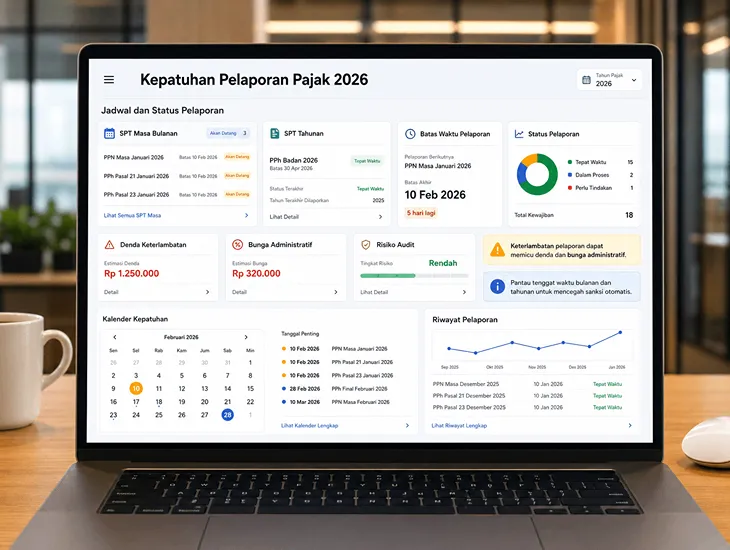
Late Tax Filing Penalties in Indonesia 2026 – Legal reporting requirements, compliance deadlines, and audit prevention
May 29, 2026

How to Avoid Late Tax Filing Penalties in Indonesia

The Indonesian tax system operates on a rigorous self-assessment basis. You must calculate, pay, and report your own tax liabilities accurately. Failing to meet these specific deadlines triggers automatic financial consequences.

Many foreign business owners struggle to navigate the local filing calendar. Managing different timelines for monthly and annual returns requires constant administrative vigilance. One minor oversight often leads to significant, compounding corporate debt.

Ignoring these deadlines creates serious legal risks for your business entity. The official tax regulations impose fixed fines and monthly interest charges for every delay. You should not treat these requirements lightly.

You need a clear strategy to protect your corporate assets effectively. Preventive measures and proactive planning ensure you remain fully compliant every quarter. Staying organized is the only way to avoid unnecessary government scrutiny.

Professional tax support simplifies these complex reporting obligations for your team. Expert advisors provide the clarity you need to manage your business. We secure your finances against sudden administrative penalties.

Proper administration keeps your company fully secure in Indonesia. You can focus entirely on your core business growth and expansion. We manage your tax compliance to minimize reporting issues.

Understanding Essential Filing Deadlines

Indonesia maintains a strict calendar for all tax obligations. Missing these mandatory dates leads to Late Tax Filing Penalties in Indonesia. You must align your accounting cycles with the national schedule. 

Individuals typically file annual returns three months after year-end. Corporate entities generally have four months to submit their returns. You must observe these critical dates to stay compliant.

Monthly returns cover various categories like income and value-added tax. These reports are due twenty days after each period ends. Consistent tracking prevents these frequent monthly reporting traps.

The tax year in Indonesia follows the standard calendar cycle. Companies using different fiscal years must adjust their internal deadlines. Accurate scheduling prevents simple, preventable errors for your business.

Automated bookkeeping systems provide necessary alerts for upcoming filing dates. Manual tracking often leads to human error and missed submission opportunities. We implement robust systems to ensure consistent, timely compliance.

Foreign investors often rely on local staff to handle these dates. However, oversight remains the responsibility of the business owner. Regular status audits ensure your reporting cycle stays perfectly on track.

Tax Penalties Indonesia 2026 – Fixed fines, interest structures, and administrative enforcement guidelinesThe government imposes fixed administrative fines for late filing submissions. These amounts vary depending on the specific tax return type. Individual returns carry smaller fixed fines than corporate returns.

A late individual annual return triggers a fixed fine. The government charges 100,000 IDR per late submission. This flat fee applies regardless of the specific duration of delay.

Corporate annual returns face a much higher penalty structure. The tax office charges 1,000,000 IDR for every late filing. These costs compound quickly for businesses with multiple entities.

Monthly value-added tax returns incur 500,000 IDR fines. Other monthly income tax returns carry smaller fixed penalty amounts. You must submit all required returns by the legal deadline.

These fines are administrative and do not reflect tax underpayment. The authority issues formal assessment letters shortly after missed deadlines. Prompt payment of these fines prevents further legal complications.

Tracking these administrative costs is essential for your annual budget. We help you categorize and monitor these expenses for your business. Prevention remains more cost-effective than managing recurring penalty assessments.

Late tax payments trigger additional monthly interest penalty charges. The interest applies from the day after the deadline passes. This charge is calculated until you settle the total debt.

The government sets these interest rates on a monthly basis. Partial months count as full months for interest calculation purposes. Even one day of delay incurs significant additional costs.

This compounding interest applies to any unpaid tax underpayment balance. It serves as an incentive for taxpayers to settle immediately. The maximum interest accumulation period is twenty-four months total.

The calculation method uses the official benchmark rate plus uplifts. This variable system makes predicting your exact liability difficult. We forecast these interest costs to help with your planning.

Business owners must prioritize payment before the official due date. Relying on government grace periods is not a valid compliance strategy. We ensure your funds move to the authorities on time.

You cannot ignore these compounding interest charges once they accrue. They increase your total financial burden significantly over time. Settle your outstanding debts promptly to minimize these ongoing costs.

Repeated non-filing leads to serious legal investigations by authorities. Negligence regarding your declarations results in criminal penalty considerations. This includes potential imprisonment for extreme or repeated cases.

The government may fine you up to double the unpaid amount. These penalties exist to enforce strict adherence to national laws. You must take every filing requirement extremely seriously today.

Intentional tax evasion causes the most severe legal consequences possible. The authority investigates discrepancies between your lifestyle and reported assets. Accurate, honest filing protects your future in the country.

First-time filing errors are treated differently than repeated intentional omissions. However, you must proactively correct any discovered mistakes immediately. We assist with voluntary corrections to mitigate your potential liabilities.

Avoid the stress of criminal investigations by maintaining perfect records. Your compliance history serves as a shield against aggressive audits. We audit your historical files to ensure complete legal transparency.

Your business deserves protection from these high-stakes legal risks. Consistent, transparent filing proves your commitment to the national regulatory system. We manage your reporting to ensure absolute peace of mind.

Meet Thomas, a forty-year-old operational director from the UK. He manages a boutique villa management firm in Uluwatu. The business grew, and his administrative workload doubled.

He relied on his local staff to track monthly filing dates. They missed the submission deadline for his corporate value-added tax return. He received a formal assessment letter soon after.

The letter demanded a fixed fine plus mounting monthly interest. Thomas felt overwhelmed by the sudden bureaucratic pressure. He urgently needed professional assistance to resolve the compliance issue.

He contacted our tax advisory firm for immediate assistance. Our team audited his corporate filings thoroughly and identified the error. We submitted the missing return documents correctly.

We negotiated with the tax office to settle the penalty assessment. Our experts managed the entire communication process with the local authorities. Thomas paid the fine and avoided further investigations.

He realized manual administration was unsustainable. Constant regulatory updates overwhelmed his team. Our service provides the stability his company needs to thrive.

Now, he focuses entirely on expanding his villa portfolio. We handle all his complex corporate tax obligations seamlessly. Reliable compliance support protects his business from severe financial penalties.

Tax Filing Extensions 2026 – Deadline management, preliminary reporting, and application guidelinesTaxpayers can legally request extensions for their annual return submissions. This option applies only to annual filings, not monthly reports. You must submit your notification before the original deadline.

Corporate entities gain up to two additional months for filing. You must provide preliminary tax calculations with your request. These documents demonstrate your intent to settle eventual liabilities.

The extension process requires detailed preliminary financial statement submissions. You must provide a valid written reason for your delay request. The authorities review every single application on its merits.

Submitting the request after the deadline results in immediate rejection. You lose your chance to delay the filing without penalty. Proper planning ensures you apply with plenty of time.

We manage your extension applications to ensure high approval rates. Our advisors prepare the preliminary calculations and financial statements correctly. We file your requests well before the official deadline.

Do not assume your extension is granted automatically by authorities. You must wait for formal approval from the tax office. We monitor your application status until the final confirmation arrives.

Use digital calendar systems to mark every upcoming tax deadline. Recurring alerts ensure you remain aware of approaching submission dates. Proactive planning eliminates the risk of last-minute errors.

Prepare your financial data well before the filing month starts. Early preparation allows time for reviewing figures and identifying errors. A calm, structured approach yields better compliance outcomes overall.

Use official online filing systems to submit your tax returns. These platforms validate your data formats before final submission occurs. They provide instant digital proof of your timely filing.

Monitor official revenue service announcements for any sudden rule changes. Tax procedures and interest rates update periodically during the year. Staying informed allows your business to adapt its financial strategy.

File your annual returns even if your business cannot pay. Submitting on time prevents the fixed penalty for late filing. We help you negotiate payment plans for any outstanding amounts.

Managing filing dates requires deep expertise in local regulatory frameworks. Missing a deadline costs money and invites unwanted government scrutiny. Small leaks drain corporate resources significantly over time.

The strict partial month rule demands absolute deadline precision always. A single day error literally costs an entire month of interest. Manual tracking simply cannot guarantee this crucial accuracy.

Foreign companies face significantly higher operational audit rates in Indonesia. Compliance errors trigger maximum penalty assessments frequently for these entities. Professional support shields your business from these targeted investigations.

Navigating new digital tax systems is highly complex for everyone. Filing delays cause widespread panic among unrepresented foreign business owners. We manage these technical transitions smoothly for our international clients.

Cross-border transactions contain hidden regulatory traps for many investors. Simple accounting errors trigger automatic withholding tax disputes with authorities. We ensure all your transfers meet strict local legal regulations.

Professional compliance support entirely eliminates the risk of penalties. We turn massive potential financial liabilities into manageable operational expenses. Protect your investment with our dedicated corporate tax services.

The authority imposes a fixed fine of 100,000 IDR for late individual annual filings.

Interest is calculated monthly based on variable rates, and partial months count as full months.

Yes, you can request a two-month extension if filed before the original April 30 deadline.

Yes, filing on time avoids the late filing fine even if you must pay the tax later.

Yes, late payments trigger monthly interest charges regardless of on-time return submission.

Need help with Late Tax Filing Penalties in Indonesia, Chat with our team on WhatsApp now!

jmacompany@gmail.com

This author has not yet provided a bio.