
Many foreign entrepreneurs running PT PMA companies in Bali are now exploring the benefits of electric car incentives in Indonesia ⚡.
The challenge begins when they face unclear rules about PKB and BBNKB tax calculations — two essential components that determine how much you’ll actually save when registering an electric vehicle under a business name 🚗.
This uncertainty often causes hesitation 🤔. Some PT PMA owners worry they might not qualify for the same tax relief as local businesses, or that regional variations could make incentives harder to claim. Without the right information, these eco-friendly investments can quickly turn into confusing paperwork.
Fortunately, Indonesia’s government supports electric vehicle adoption through policies offering significant PKB (Motor Vehicle Tax) and BBNKB (Title Transfer Fee) reductions for electric vehicles 🌿.
When handled correctly through tax filing and reporting compliance for PT PMA, foreign companies can access the same privileges as local entities — reducing annual ownership costs and supporting sustainable growth.
A Bali-based hospitality company recently registered two electric cars under its PT PMA name and successfully received local tax discounts 💼.
They confirmed that by following DJP Online and Samsat procedures accurately, the process was faster and simpler than expected — proving that compliance and sustainability can go hand in hand.
So if your goal is to optimize operating costs while promoting green mobility in Bali, now is the time to act. Check your province’s PKB and BBNKB incentive guidelines and consult a licensed accountant in Bali to confirm eligibility.
With proper steps and documentation, your PT PMA can drive toward a cleaner future — with lower taxes and higher efficiency 🚀.
Table of Contents
- Understanding PKB and BBNKB Tax Incentives for Electric Cars ⚡
- How PT PMA Owners in Bali Qualify for EV Incentives 💼
- Step-by-Step BBNKB Calculation Guide for Electric Cars 📄
- How to Claim PKB Tax Reductions for Registered EVs in Indonesia 🌿
- Key Documents for Electric Vehicle Registration in Bali 🧾
- Comparing Electric Car Taxes vs. Conventional Vehicles 🚗
- Common Mistakes PT PMA Owners Make in EV Tax Filing ⚠️
- 💬 Real Story: How a Bali Company Saved on PKB & BBNKB Costs
- FAQs About Electric Car Incentives and BBNKB Calculation ❓
Understanding PKB and BBNKB Tax Incentives for Electric Cars ⚡
Indonesia’s government has launched multiple programs to support electric vehicle adoption 🌿. Among them are the PKB (Motor Vehicle Tax) and BBNKB (Title Transfer Fee) reductions. Both taxes can be drastically lower for EVs compared to traditional fuel vehicles, helping companies save millions each year.
According to the Ministry of Finance (kemenkeu.go.id), local governments may reduce PKB tax by up to 90%, while BBNKB calculation can be discounted by as much as 100% for fully electric vehicles. These policies are part of Indonesia’s transition toward a low-carbon economy.
For PT PMA companies in Bali, this means a clear financial incentive to switch to electric fleets. Instead of paying the full registration fee, your business could benefit from PKB and BBNKB tax incentives that directly lower operational costs and demonstrate environmental commitment 🌏.
If you’re unsure about regional rules, check with your local Samsat Bali office for the latest EV-related tax exemptions and rates.
Good news — foreign-owned companies (PT PMA) are fully eligible for electric car incentives in Indonesia. To qualify, the vehicle must be registered under the PT PMA’s legal entity name, not an individual employee.
You’ll need to prove that the EV is used for legitimate business operations — such as client transport, logistics, or hospitality purposes. When you register your EV, the DJP Online system automatically cross-checks your tax profile to confirm company eligibility.
To strengthen your application, ensure your PT PMA’s NPWP and NIB documents are active and updated. These are crucial for verifying corporate identity during electric vehicle registration in Bali.
When your documentation aligns, local authorities apply the Bali EV tax reduction automatically — giving your company access to both short-term and long-term savings 🚗.
Calculating BBNKB (Bea Balik Nama Kendaraan Bermotor) can seem tricky at first, but it’s simpler when broken into clear steps.
🔹 Step 1 — Check Base Value: Confirm the taxable value (NJKB) from Samsat Bali’s official list.
🔹 Step 2 — Apply the Rate: For conventional cars, BBNKB is 10% of NJKB, but for electric vehicles, it may drop to 0%–2.5% depending on local policy.
🔹 Step 3 — Add Administrative Fees: Include minor costs such as plate issuance and administration (usually under Rp 1 million).
🔹 Step 4 — Calculate Total Cost:
Example — If your EV’s NJKB = Rp 400 million and BBNKB rate = 2.5%, you pay Rp 10 million.
By using this formula, PT PMA electric car benefits become easy to estimate before registration. Keeping records organized ensures a smoother process when claiming tax reductions or audits later.

After registering your EV, you can officially claim PKB tax reductions through local tax offices or the Samsat Go app.
Here’s how it works:
✅ Submit the EV registration certificate (STNK) under your company name.
✅ Attach proof of purchase and invoice clearly identifying it as a battery electric vehicle.
✅ Request PKB discount verification from your provincial revenue office.
Once approved, the PKB tax appears as a reduced amount on your annual renewal statement. Some regions, including Jakarta and Bali, even grant full exemptions for the first few years of ownership.
By maintaining clean tax records and paying on time via DJP Online, PT PMA directors show compliance — earning trust from both regulators and clients 🌏.
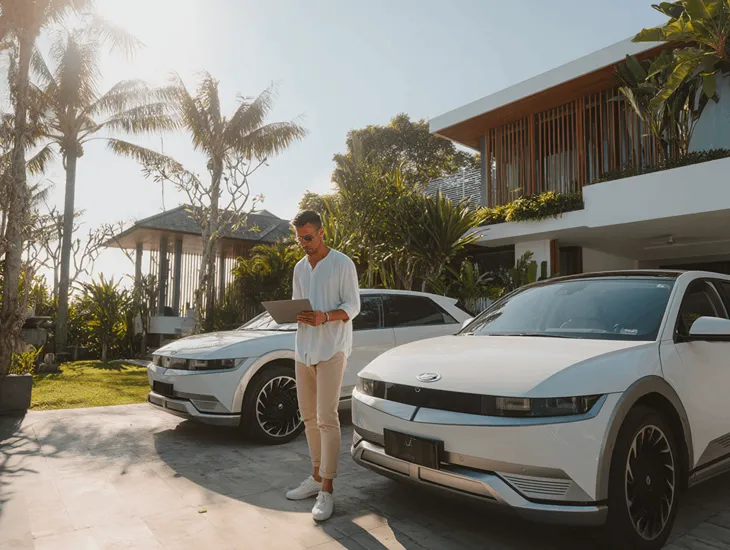
Before enjoying electric car incentives, prepare these documents carefully:
📄 Company NPWP & NIB — Verify PT PMA legality through OSS.go.id.
📄 Invoice & Import Documents — If your EV was imported, customs paperwork must match the declared value.
📄 Vehicle Identification Number (VIN) — Confirms it’s a full EV, not hybrid.
📄 STNK & BPKB — Issued by Samsat Bali for ownership proof.
📄 Tax Payment Receipt — Needed to activate future PKB renewals.
Organizing these early prevents costly delays or errors. Many foreign entrepreneurs rely on licensed tax consultants in Bali to manage submissions, ensuring every form meets DJP standards 💼.
The difference between owning a gasoline car and an electric car in Indonesia is huge — not only environmentally but financially 💰.
A standard 1.5 L gasoline sedan may attract 10% BBNKB and 2% PKB annually. An EV of similar class might enjoy 0% BBNKB and only 0.2% PKB, thanks to ongoing PKB and BBNKB tax incentives.
That means your company could save up to Rp 15 million per year, depending on your region’s policies.
EVs also reduce long-term maintenance and fuel costs. By switching early, PT PMA businesses can present themselves as eco-friendly innovators, gaining an image advantage and meeting upcoming government sustainability targets 🌿.
For the full breakdown, refer to bapenda.baliprov.go.id’s EV tax page.
Even with good intentions, some PT PMA owners still make errors during EV tax filing:
⚙️ Using personal NPWP instead of company NPWP → makes the EV ineligible for business incentives.
📄 Missing BBNKB receipt copies → auditors may reject deductions.
💸 Incorrect PKB rate entries in accounting systems → causes Coretax mismatch.
🕐 Late STNK renewals → penalties remove your incentive benefit.
To avoid these, use Coretax Lite DJP for organized e-filing and maintain a shared digital archive. Compliance isn’t just about rules — it’s about credibility and long-term savings 🌏.

Meet Daniel Reynolds, a 32-year-old entrepreneur from Australia who runs PT EcoDrive Bali, a villa-transport company in Canggu. He wanted to modernize his fleet while cutting costs.
In 2024, he purchased two Hyundai IONIQ 5 EVs for guest transfers. Daniel initially hesitated because the BBNKB calculation seemed complicated. After consulting a licensed accountant in Bali, he learned his company qualified for the electric car tax calculation Indonesia program, which offered nearly full BBNKB exemption.
He submitted documents via OSS Indonesia and cross-checked rates through bapenda.baliprov.go.id. Within a month, he received confirmation of PKB tax reductions totaling over Rp 25 million.
“Switching to EVs was smoother than expected,” Daniel said. “It helped us meet Bali’s sustainability trend and saved us money.”
His experience shows that foreign PT PMA owners can combine E-E-A-T principles — real experience, expert guidance, and trustworthy records — to unlock genuine PT PMA electric car benefits and inspire others to act.
Yes. As long as it’s under the company name with valid NPWP & NIB.
You may get up to 90% off PKB and 100% off BBNKB for full EVs — check bapenda.baliprov.go.id.
Usually no — incentives apply only to battery electric vehicles (BEVs).
Contact your regional Samsat office or visit kemenkeu.go.id’s EV policy page.
For ownership, yes — but local registration requires a resident representative with KITAS or KITAP status.
Yes, reach out to baliaccountants.com for assistance with tax registration and compliance.
Need help calculating PKB & BBNKB for your electric car? ⚡ Chat with our team on WhatsApp! ✨
Gita
Gita is graduate from Udayana University and a dedicated blog writer passionate about crafting meaningful, insightful content with focus on topics related to work, productivity, and professional growth.