
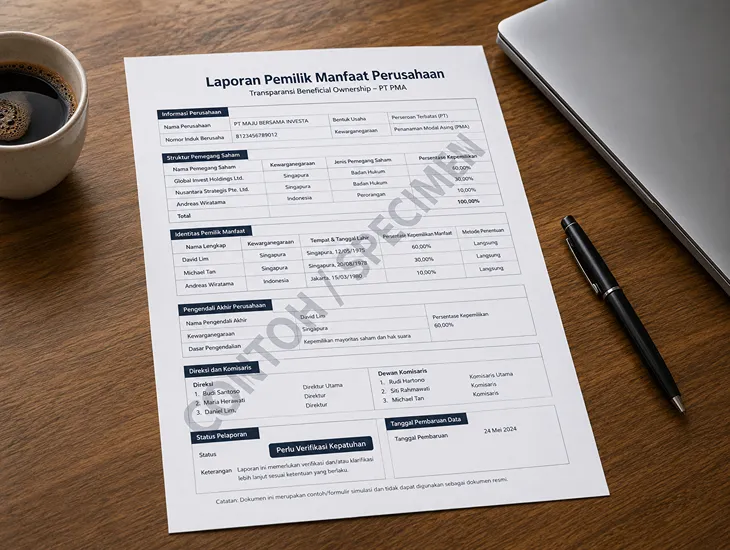
Beneficial Ownership Rules in Indonesia 2026 – Legal filing requirements, PT PMA compliance, and tax transparency regulations for WNAs
May 22, 2026

Beneficial Ownership Rules in Indonesia: Supporting Tax Transparency Through Law Ministry Reforms

Investors face structural friction when managing companies in Indonesia. Shifting rules expose entities to unexpected liabilities. This friction halts corporate growth across emerging sectors.

Failing to meet identity standards causes severe operational problems. Administrative oversights attract suspicion from central authorities. Opaque ownership faces intense institutional pushback from state regulators.

Corporations cannot hide behind layers of anonymous partners. Regulators freeze operations if files appear outdated. This obstruction paralyzes your local investment strategy completely.

The government introduced vital reforms to enforce disclosures. These updates regulate hidden stakeholders across all entities. Adapting successfully requires specialized local compliance knowledge.

These updates support Beneficial Ownership Rules in Indonesia. The shift ensures total transparency for foreign investors. Legitimate enterprises must update profiles now.

Our advisors align your business with official tax regulations seamlessly. We eliminate structural risks to protect your assets safely and professionally.

Evolution of Transparency Requirements in Indonesia

Identifying the true controlling persons of a domestic enterprise represents a foundational shift in corporate governance. Presidential Regulation Number 13 of 2018 introduced early measures to combat hidden financial arrangements.

Early protocols relied primarily on self-declaration mechanisms which lacked aggressive auditing features. Consequently, many complex ownership layers remained unverified by state regulators. This regulatory gap allowed opaque structures to persist.

Global standards now dictate that supreme authorities must maintain verifiable corporate registries. Indonesia actively aligns its internal legal frameworks with international anti-money laundering expectations. Compliance is now a continuous operational standard.

The corporate registry now acts as a primary tool for regulatory oversight. Every registered entity must adapt to these changing verification protocols to secure its legal standing. Outdated reporting structures attract immediate audits.

Modern companies must look past basic paper documentation to identify actual controlling figures. This evolutionary tracking process demands sophisticated legal oversight and continuous compliance management. Ignoring these changes creates profound corporate exposure.

Adapting to these international standards secures your company operations against sudden legal challenges. Local enterprises must establish proactive corporate tracking routines to satisfy auditing requirements.

This structural tracking matches the modern global shift toward radical tax transparency. Businesses must treat data synchronization as an asset-protection metric to prevent sudden corporate disruptions.

Beneficial Ownership Rules in Indonesia 2026 – Statutory shareholder thresholds and corporate transparency systems
The legal definition of a controlling individual extends beyond basic company registration documents. Authorities look directly for individuals who possess ultimate decision-making power over the corporate infrastructure.

A primary indicator of control involves holding a minimum stake of twenty-five percent of total corporate shares. This mathematical benchmark serves as an initial trigger for mandatory disclosure protocols.

However, individuals who hold smaller percentages but exercise total control through specific agreements also qualify. The authority to appoint or remove corporate directors represents an undeniable sign of controlling power.

Ultimate control also includes individuals who receive direct or indirect financial benefits from company operations. The state tracks all incoming revenue streams to identify the true owner of corporate capital.

These combined criteria ensure that nominee arrangements cannot obscure actual ownership patterns. Every enterprise must evaluate its leadership structure against these strict parameters to maintain legal compliance.

Complex holding arrangements must trace ownership back to natural persons. Layered corporate tiers cannot legally hide the identity of ultimate controllers from modern state investigations.

Ministry of Law and Human Rights Regulation Number 2 of 2025 drastically alters corporate disclosure duties. This new directive enforces a shift from simple declarations to rigorous collaborative verification networks.

Every corporate vehicle is subject to these comprehensive oversight protocols. The mandate applies broadly to limited liability companies, partnerships, foundations, and single-person operations. Every structure requires systematic tracking.

Corporations must implement strict internal tracking mechanisms to verify their controlling persons constantly. This process involves gathering valid identity documents and mapping out complex offshore holding structures completely.

Data must be submitted electronically through the specialized government database infrastructure. This centralized repository provides immediate information access to various law enforcement agencies and judicial bodies during active financial audits.

This updated framework transforms reporting from a single initial event into a permanent governance routine. Your leadership team must review ownership profiles regularly to prevent critical administrative discrepancies.

Non-compliance parameters are now linked directly with active corporate risk profiles. Regulators monitor electronic activities to ensure no discrepancies remain unaddressed within the central network infrastructure.

The introduction of the automated data verification gateway marks the end of simple self-declaration filing. Government systems now cross-reference submitted data with multiple secondary state databases automatically to ensure absolute accuracy.

The Ministry of Law coordinates directly with revenue offices and land administration departments. This integrated grid allows investigators to trace assets across independent platforms effortlessly. Opaque holding networks are rapidly uncovered.

Notaries play a formalized role within this new collaborative verification network. These legal officers must validate documentation before submitting profiles to the central registry portal. This step adds a layer of institutional oversight.

High-risk entities face intensive document-based examinations and unannounced on-site inspections. Regulators analyze corporate questionnaires to identify hidden controllers who operate outside formal company records. Proactive compliance minimizes these operational disruptions.

Maintaining inconsistent data across different banking or immigration platforms flags your business for immediate investigation. Your corporate record must be entirely consistent to satisfy government verification systems.

Complex corporate structures holding assets face profound exposure under these updated verification guidelines. Traditional nominee arrangements used for land ownership or villa management are prime targets for intense regulatory examination.

If reported data does not match actual operational control, authorities issue immediate administrative sanctions. These penalties include written warnings, blacklisting, and blocking access to the electronic legal services portal.

Losing portal access prevents your enterprise from modifying its board of directors or updating corporate bylaws. This operational paralysis severely harms your commercial relationships and prevents standard banking activities.

International business networks and local partnerships will treat unverified corporations with severe caution. Financial institutions routinely deny credit or freeze accounts if hidden ownership flags appear during risk assessments.

Understanding these severe risks allows foreign investors to reorganize their holding structures safely. True adherence to the current Beneficial Ownership Rules in Indonesia requires eliminating non-transparent proxy setups completely.

Nominee shareholders who act as legal placeholders must be formally declared alongside actual overseas funders. Hiding foreign beneficiaries under local names violates current legal reporting thresholds.

Indonesia Corporate Tax 2026 – Legal proxy disclosures, PT PMA verification, and financial audits in BaliMeet Beat, a 45-year-old eco-resort developer from Austria. He moved to Ubud to launch a sustainable hospitality company. He hired a local team to manage operations across the region.

Beat utilized a complex offshore holding arrangement to secure initial international capital for his venture. His team formally registered the company structure at the central corporate registry during establishment.

However, during a routine system update, the central platform flagged his account for a severe verification mismatch. The automated system detected that his reported data conflicted with immigration records.

The government instantly blocked his access to online administrative portals. Beat could not update his business operational licenses or process monthly payroll transactions. This structural obstruction threatened his entire resort launch.

He utilized our professional corporate advisory and tax compliance services to resolve the crisis. Our team systematically mapped his entire corporate structure to identify the true controlling individuals accurately.

We submitted a comprehensive disclosure package and successfully cleared the government verification audit within days. Beat restored his portal access and now operates his eco-resort with complete legal confidence.

The central corporate registry connects directly with the Directorate General of Taxes database. Revenue officers utilize this integrated portal to cross-reference personal asset declarations with corporate profit distributions.

Disclosures are vital for identifying the true recipients of corporate dividends, interest, and royalties. Revealing these financial pathways prevents foreign entities from using artificial nominee layers for tax avoidance.

Discrepancies between your corporate records and international information exchange reports trigger immediate tax audits. The tax office aggressively scrutinizes layered structures that lack genuine local commercial substance.

Aligning your operational reporting with tax expectations is a strategic corporate necessity. Legitimate enterprises utilize approved incentives transparently while maintaining full visibility. This balance minimizes the risk of costly tax disputes.

Our compliance experts ensure your corporate governance records match your annual tax returns perfectly. This comprehensive coordination shields your business from being categorized as a high-risk financial entity.

Cross-border wealth allocation models face extreme transactional scrutiny under the unified digital audit gateway. Transparency is the only definitive mechanism to secure local capital from external investigations.

Modern corporate compliance requires a permanent, proactive management strategy. Your organization cannot treat identity disclosures as a simple, one-time filing task. It is a living profile that requires annual maintenance.

We provide comprehensive diagnostic mapping to verify your true controlling individuals legally. Our team prepares detailed corporate files that satisfy both the Ministry of Law and tax authorities.

Our services include managing annual reporting questionnaires and updating central registry profiles seamlessly. We set strict calendar controls so your data never becomes stale or non-compliant under current guidelines.

For expat families and international investment groups, we integrate identity compliance into your broader relocation plans. This early preparation secures your banking, immigration, and fiscal positions from day one.

Professional oversight removes administrative stress and protects your business from disruptive operational blocks. Let our dedicated team manage your corporate governance safely. Secure your commercial future in Indonesia today.

Individuals holding 25% shares or exercising ultimate operational control.

Permenkumham 2/2025 mandates that all entities perform updates at least once per year.

Penalties include corporate blacklisting and blocking vital portal access.

Yes, one-person companies must fully disclose their controlling individuals through the AHU system.

Yes, users can search corporate profiles via the official government AHU portal online.

Regulators cross-reference data to detect layered structures used for aggressive tax evasion.

Need help with Beneficial Ownership Rules in Indonesia, Chat with our team on WhatsApp now!

jmacompany@gmail.com

This author has not yet provided a bio.