
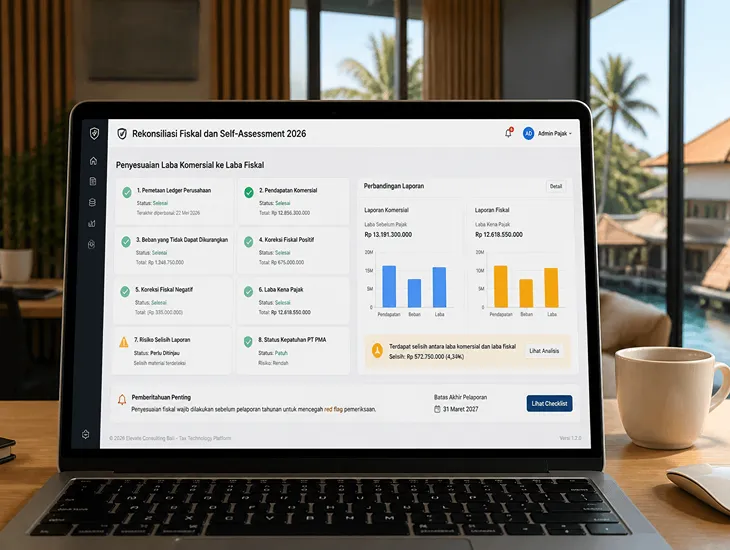
Self-Assessment System and Fiscal Reconciliation: Their Connection in Indonesia

Foreign business owners face strict reporting obligations locally. Transitioning corporate revenue into formal tax filings creates immense friction for expatriate managers.
State regulators place the calculation burden directly on corporate taxpayers. Failing to map ledgers properly leaves foreign enterprises exposed to severe administrative penalties.
Unmatched accounting frameworks trigger immediate red flags during government reviews. Revenue officers penalize commercial entities that submit unadjusted profit statements without executing statutory modifications.
These documentation errors freeze vital corporate banking channels. Operating with mismatched financial ledgers directly threatens your long-term commercial residency and local business stability.
Aligning data with official tax regulations resolves these compliance threats completely. Proper book adjustments bridge the gap between commercial accounting and mandatory state reporting.
Our specialized advisory team handles your complete tax preparation process. We ensure your annual financial submissions remain perfectly aligned with strict domestic revenue frameworks.
Table of Contents
- Core Obligations Under the Domestic Reporting Regime
- Bridging Commercial Profit to Taxable Income in Indonesia
- Identifying Positive and Negative Profit Corrections
- Navigating the Coretax Data Entry Process in Indonesia
- Real Story: Securing Corporate Compliance in Sanur
- State Supervision and Auditing Risk Factors
- Managing Financial Mapping for Foreign Companies
- Comprehensive Tax Architecture for Local Ventures
- FAQs about Self-Assessment System and Fiscal Reconciliation
Core Obligations Under the Domestic Reporting Regime
The local state revenue apparatus requires foreign business owners to calculate and remit their corporate taxes independently. This framework places heavy legal responsibility directly on your corporate management teams.
Companies must submit comprehensive annual returns detailing all financial assets and commercial liabilities. Revenue officers supervise these submissions instead of pre-calculating the corporate tax burden for the taxpayers.
Filing deadlines remain strictly enforced across all active commercial sectors locally. Individual taxpayers must file by March, while corporate entities have until late April to finalize their required annual documentation.
Late submissions or missing attachments trigger severe administrative sanctions immediately during routine reviews. Authorities treat incomplete tax filings as unsubmitted, exposing the commercial enterprise to escalating financial penalties.
Proper accounting adjustments remain absolutely essential under this strict domestic reporting structure. Understanding the connection between the Self-Assessment System and Fiscal Reconciliation protects your enterprise from unwanted government intervention.
Our dedicated accounting specialists manage your annual tax preparation from start to finish. We ensure your corporate submissions meet every strict statutory deadline reliably to protect your overall commercial assets.
Commercial accounting standards rarely match state revenue reporting requirements perfectly across all sectors. This fundamental discrepancy requires local businesses to modify their internal profit and loss statements annually.
Corporate accountants must adjust standard commercial profits to calculate true taxable income properly. This critical conversion process legally aligns internal bookkeeping records with rigid national tax regulations.
State regulations dictate specific rules for equipment depreciation, non-deductible expenses, and exempt corporate revenue. Ignoring these statutory deviations guarantees inaccurate tax calculations and massive compliance failures during formal state evaluations.
Applying commercial ledger modifications bridges this complex tax reporting gap completely. It transforms standard business ledgers into fully compliant state revenue declarations, securing your enterprise against unexpected corporate penalties.
Submitting unadjusted commercial profits invites immediate institutional audits from vigilant tax authorities. Regional tax officers demand precise financial mapping to verify your final corporate tax base accurately before issuing clearances.
Implementing the Self-Assessment System and Fiscal Reconciliation prevents sudden audit penalties. Our team synchronizes your daily commercial ledgers with rigid annual tax requirements to ensure flawless compliance.

Adjusting commercial profit involves applying specific statutory corrections to your corporate ledgers meticulously. These mandatory modifications either increase or decrease your final taxable corporate income figure according to state laws.
Positive corrections increase your total taxable profit directly during the annual calculation phase. This occurs when companies deduct expenses that state authorities explicitly disallow, such as specific administrative penalty fines.
Income tax borne by the corporation also triggers a mandatory positive addition immediately. Financial controllers must add these non-deductible costs back into the taxable profit calculation accurately to ensure compliance.
Conversely, negative corrections legally decrease your final taxable income during the reporting cycle. This applies when your company earns revenue that has already been subject to final tax withholding provisions.
Certain inter-corporate dividends represent exempt income and require precise negative adjustments annually. Applying these legal reductions prevents double taxation and protects your corporate working capital effectively from unnecessary government depletion.
Our tax experts categorize your complex corporate transactions to apply these corrections flawlessly. We maximize your legal deductions while maintaining absolute adherence to current state regulations to protect your investments.
Modern corporate reporting utilizes advanced digital interfaces to process annual tax returns efficiently. Taxpayers must map their internal chart of accounts directly to the mandatory state digital format perfectly.
This digital platform requires precise manual entry of all modified income and expense lines. Corporate controllers must reconcile their financial position data consistently across multiple complex digital reporting tabs.
Pre-populated digital features remain restricted to entities using specialized financial reporting formats locally. Standard commercial operators must input their modified accounting amounts manually and cautiously to avoid triggering automated mismatches.
Input errors during this digital mapping phase generate immediate system-wide warnings. Discrepancies between your audited accounts and the central digital portal trigger automated compliance reviews rapidly by state investigators.
When Thomas, a hospitality software developer from Australia, first arrived in Sanur, he struggled with complex accounting hurdles. His internal team failed to align international financial ledgers with local regulations.
His bookkeepers mistakenly submitted raw commercial profits without applying mandatory positive adjustments for non-deductible corporate expenses. The central database flagged these glaring reporting omissions immediately during a routine digital review.
This severe data mismatch triggered an intense regional tax audit by local authorities. The impending institutional scrutiny threatened his commercial liquidity and severely disrupted his ongoing software deployment schedules.
Thomas utilized our professional tax mapping service to overhaul his corporate ledgers completely. We restructured his chart of accounts to integrate all necessary negative and positive corrections accurately and systematically.
Our experts submitted a verified, fully reconciled tax package to the revenue office within days. This rapid intervention closed the audit proceedings and protected his corporate banking channels safely.
Thomas now runs his technology firm under a robust, fully monitored compliance framework. This systematic alignment guaranteed operational continuity and secured his technology assets against unforeseen institutional shocks.
State revenue officers rely strictly on adjusted tax data to verify corporate compliance accurately. Modifying commercial profit remains the primary control point for authorities monitoring international business operations across the archipelago.
Auditors cross-reference your annual tax return with your formal financial statements. They also compare your corporate data with third-party banking records and monthly value-added tax filings to detect anomalies.
Poor internal ledger management increases your exposure to formal clarification letters significantly over time. Unexplained discrepancies between commercial revenue and taxable income invite deep institutional investigations immediately from vigilant state agents.
Authorities deploy automated risk parameters to detect unusual non-deductible cost patterns efficiently. High expense ratios compared to reported industry averages trigger immediate systemic alerts for regional investigators managing the corporate database.
Executing the Self-Assessment System and Fiscal Reconciliation flawlessly shields your enterprise from these aggressive audits. Clean financial data prevents unnecessary state intervention and protects your organizational reputation among local commercial partners.

Foreign-owned corporate groups must comply with local reporting standards. International accounting rules frequently conflict with rigid domestic taxation frameworks enforced strictly across the commercial archipelago.
Multi-currency bookkeeping complicates annual profit adjustments for foreign founders. Financial teams must apply precise currency conversion methods to determine taxable income accurately before submitting final documents.
Handling intercompany charges and management fees requires careful regulatory mapping. Improperly classified transactions often lead to severe transfer pricing adjustments implemented retroactively by state revenue officers.
Expatriate business owners often struggle to separate personal expenses from corporate ledgers. Blending private spending with commercial accounts guarantees positive corrections during formal state compliance audits.
We specialize in translating international financial data into compliant domestic tax formats. Our experts resolve multi-currency discrepancies to keep your corporate architecture aligned with modern state requirements.
Let our professionals handle your complex cross-border financial reporting obligations. We ensure your foreign enterprise thrives safely within the regulatory landscape without facing institutional friction.
Developing a resilient corporate footprint demands complete alignment with evolving state reporting mandates. Sophisticated business owners treat annual profit adjustments as the fundamental foundation of their long-term regional growth strategies.
Maintaining clean data records allows your enterprise to clear automated state reviews effortlessly. Flawless corporate ledgers support unbroken organizational momentum and secure your regional commercial assets firmly against institutional penalties.
Professional tax advisory support shields your business from costly administrative friction. We translate complex regional tax regulations into secure, highly actionable financial blueprints for international corporate management teams.
Integrating precise commercial adjustments into your daily operations ensures absolute compliance. Consistent financial tracking optimizes your corporate capital allocation and protects your profit margins from unexpected domestic regulatory shifts.
Partnering with our specialized local firm establishes a bulletproof foundation for your ongoing commercial expansion. We navigate the intricate regional tax framework completely so you can focus strictly on scaling efficiently.
Mastering these reporting frameworks secures your regional commercial assets firmly. Our comprehensive accounting solutions guarantee flawless execution and total legal confidence for foreign founders operating locally.
Taxpayers must independently calculate, pay, and report their corporate taxes accurately.
Accounting standards and tax regulations differ regarding deductible expenses.
It adds non-deductible expenses back to your profit, increasing your taxable income.
They subtract exempt revenue or final-taxed income, legally decreasing your taxable income.
Data discrepancies trigger automated systemic warnings and invite immediate regional tax audits.
No, international firms must translate their ledgers into compliant domestic tax formats.
Need help with the Self-Assessment System and Fiscal Reconciliation, Chat with our team on WhatsApp now!
jmacompany@gmail.com
This author has not yet provided a bio.